Neurons, Linear Models
Leaky Integrate-and-Fire (LIF)
Formulation
With solution:
After an action potential is generated:
Where:
\(I\), total input current applied to the neuron \((\text{nA})\)
\(V_m\), electric potential difference across the cell membrane \((\text{mV})\)
\(V_\text{rest}\), equilibrium of the membrane potential \((\text{mV})\)
\(V_\text{reset}\), membrane potential difference set after spiking \((\text{mV})\)
\(\tau_m\), membrane time constant \((\text{ms})\)
\(t\), current time of the simulation \((\text{ms})\)
\(\Delta t\), length of time over which each simulation step occurs \((\text{ms})\)
Description
This model defines the basic leaky integrate-and-fire neuron, without the incorporation of adaptive behavior or “biologically defined reset rules”. This is equivalent to the GLIF1 (generalized leaky integrate-and-fire) model. Without presynaptic current, the membrane voltage decays back towards the rest voltage with rate in inverse proportion to the membrane time constant.
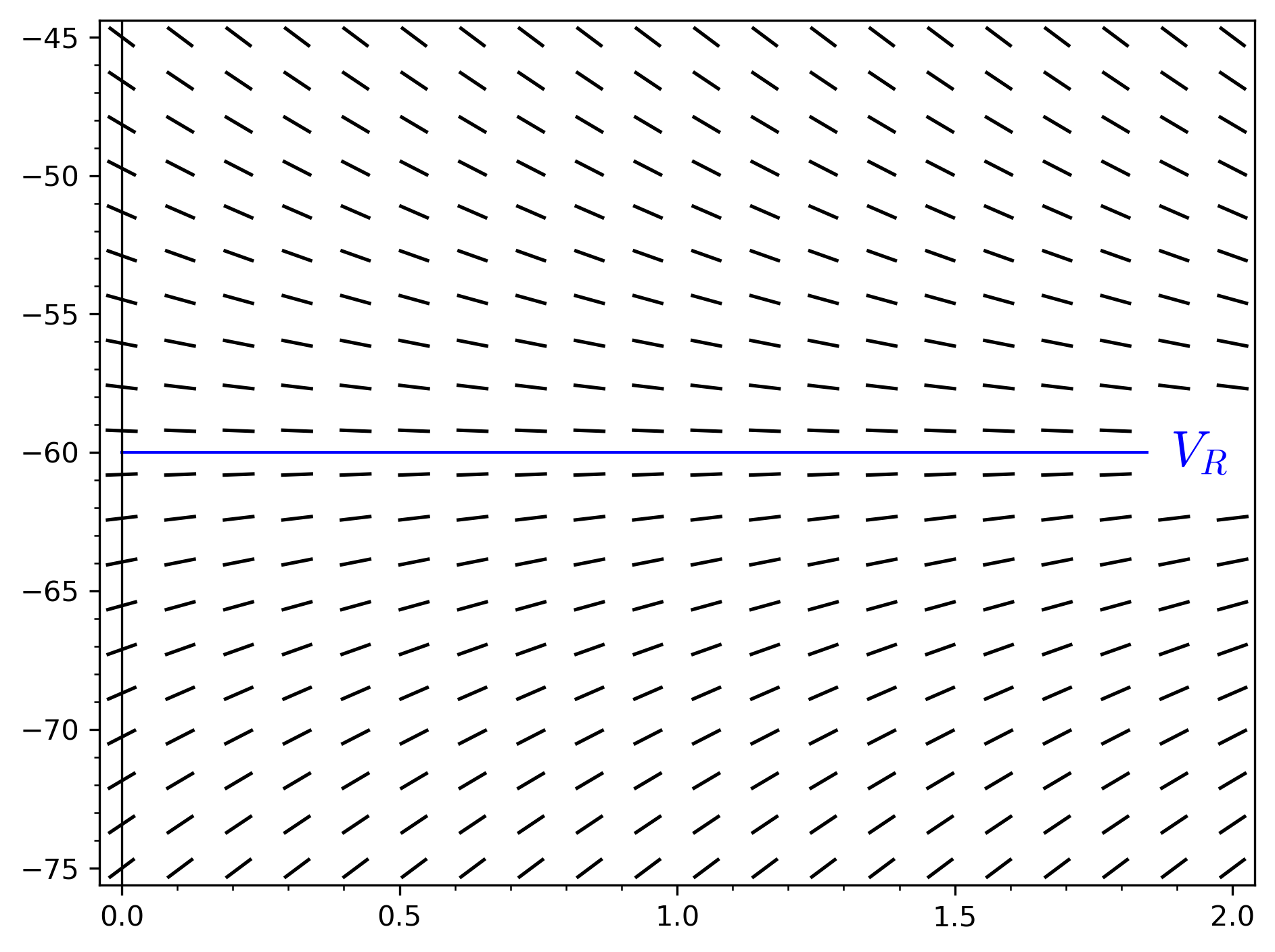
Slope field of the membrane voltage without any input current showing the decay towards the rest voltage \((V_R = -60 \text{ mV})\) over time. Plotted with value \(\tau_m=1 \text{ ms}\) over a time of \(2 \text{ ms}\).
Alternative Formulations
In the first alternative formulation, the membrane resistance \(R_m\), given in \(\text{M}\Omega\), is not multiplied into each side, leaving the membrane capacitance \(C_m\), given in \(\text{nF}\).
In the second alternative formulation, rather than considering the resistance of the membrane, it is instead phrased in terms of the membrane’s leak conductance \(g_L\), given in \(\mu\text{S}\).
These formulations are all equivalent, but expose different underlying properties of the neuron. Given the formulation used in Inferno, the other values can be calculated as follows.
References
Adaptive Leaky Integrate-and-Fire (ALIF)
Formulation
With solutions:
After an action potential is generated:
Where:
\(I\), total input current applied to the neuron \((\text{nA})\)
\(V_m\), electric potential difference across the cell membrane \((\text{mV})\)
\(V_\text{rest}\), equilibrium of the membrane potential \((\text{mV})\)
\(\tau_m\), membrane time constant \((\text{ms})\)
\(\Theta\), membrane potential at which an action potential is generated \((\text{mV})\)
\(\Theta_\infty\), equilibrium of the firing threshold \((\text{mV})\)
\(\theta_k\), adaptive component of the firing threshold \((\text{mV})\)
\(\theta_\text{reset}\), reset value of the adaptive component of the firing threshold \((\text{mV})\)
\(d_k\), spike-triggered voltage threshold adaptation \((\text{mV})\)
\(\tau_k\), adaptation time constant \((\text{ms})\)
\(t\), current time of the simulation \((\text{ms})\)
\(\Delta t\), length of time over which each simulation step occurs \((\text{ms})\)
Description
This model uses the underlying dynamics of the leaky integrate-and-fire neuron, but it incorporates a spike-dependent adaptive threshold. This is equivalent to the GLIF2 (generalized leaky integrate-and-fire) model with the exception of membrane reset voltage behavior.
References
Generalized Leaky Integrate-and-Fire 1 (GLIF1)
Generalized Leaky Integrate-and-Fire 2 (GLIF2)
Formulation
With solutions:
After an action potential is generated:
Where:
\(I\), total input current applied to the neuron \((\text{nA})\)
\(V_m\), electric potential difference across the cell membrane \((\text{mV})\)
\(V_\text{rest}\), equilibrium of the membrane potential \((\text{mV})\)
\(m_v\), spike-triggered voltage fraction, as slope \((\text{1})\)
\(b_v\), spike-triggered voltage addition, as intercept \((\text{mV})\)
\(\tau_m\), membrane time constant \((\text{ms})\)
\(\Theta\), membrane potential at which an action potential is generated \((\text{mV})\)
\(\Theta_\infty\), equilibrium of the firing threshold \((\text{mV})\)
\(\theta_k\), adaptive component of the firing threshold \((\text{mV})\)
\(\theta_\text{reset}\), reset value of the adaptive component of the firing threshold \((\text{mV})\)
\(d_k\), spike-triggered voltage threshold adaptation \((\text{mV})\)
\(\lambda_k\), adaptation rate constant \((\text{ms}^{-1})\)
\(t\), current time of the simulation \((\text{ms})\)
\(\Delta t\), length of time over which each simulation step occurs \((\text{ms})\)
Description
Also called “leaky integrate-and-fire with biologically defined reset rules (LIF-R)”, this model uses conventional LIF dynamics, with a linear spike-dependent adaptive threshold and a reset voltage which is contingent on the membrane voltage reached when spiking. Note that the adaptation decay is defined in terms of a rate constant \(\lambda_k\) rather than a time constant \(\tau_k\).
References
Generalized Leaky Integrate-and-Fire 3 (GLIF3)
Work In Progress
This is not yet implemented and the documentation is incomplete.
Generalized Leaky Integrate-and-Fire 4 (GLIF4)
Work In Progress
This is not yet implemented and the documentation is incomplete.
Generalized Leaky Integrate-and-Fire 5 (GLIF5)
Work In Progress
This is not yet implemented and the documentation is incomplete.